

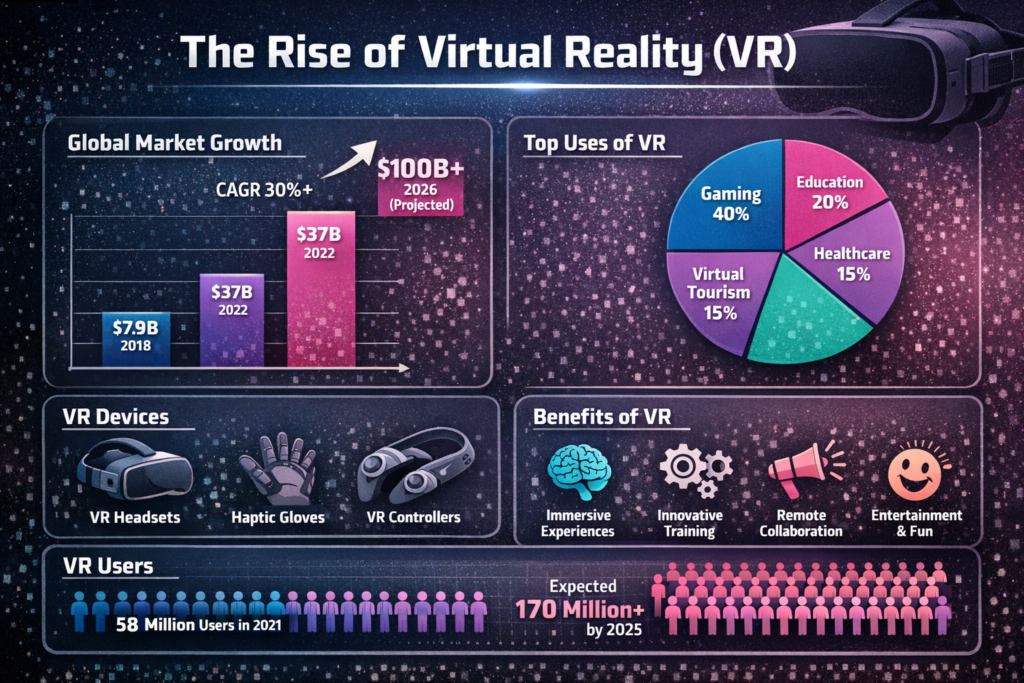
Virtual Reality (VR)
Tech Terms Daily – Virtual Reality (VR)
Category — A.I. (ARTIFICIAL INTELLIGENCE)
By the WebSmarter.com Tech Tips Talk TV editorial team
1 | Why Today’s Word Matters
Virtual Reality (VR) has evolved far beyond gaming headsets and sci-fi movies. In 2025, VR is a powerful platform for immersive experiences in education, healthcare, real estate, retail, training, and even remote work. But the real transformation comes when VR is powered by Artificial Intelligence (AI).
AI-driven VR environments don’t just look realistic—they think, react, and adapt to users in real time. Imagine training simulations that adjust difficulty based on your performance, virtual shopping assistants that understand your preferences, or architectural walk-throughs that redesign themselves instantly when you request changes.
This blend of AI and VR is opening doors to personalized, interactive, and data-rich experiences that were once impossible. For businesses, it means more engaging customer interactions, more effective training, and smarter decision-making through immersive visualization. Ignoring VR in your AI strategy now could mean falling behind in industries where experience is everything.
2 | Definition in 30 Seconds
Virtual Reality (VR) for Artificial Intelligence:
The integration of AI algorithms into immersive, computer-generated 3D environments, enabling those environments to respond intelligently, personalize experiences, and learn from user interactions for enhanced engagement and functionality.
It answers four critical questions:
- How can immersive environments become more realistic and interactive?
- Can AI adapt VR scenarios to individual users in real time?
- How can VR + AI improve training, customer service, and decision-making?
- What data can be collected and analyzed to refine these experiences?
Think of it as stepping into a smart, responsive world that learns and grows with you.
3 | Why AI-Powered VR Is a Game Changer
| VR Without AI | VR With AI Integration |
| Pre-programmed, static experiences | Adaptive, personalized experiences |
| Limited interactivity | Natural language, gesture, and emotion response |
| Fixed difficulty in training | Dynamic difficulty based on real-time performance |
| Minimal data collection | Detailed analytics for improvement |
| One-size-fits-all scenarios | Tailored content for each individual user |
4 | Key Applications of AI in VR
- Training & Simulation – Adaptive learning scenarios for pilots, surgeons, factory workers, and customer service teams.
- Retail & E-Commerce – Intelligent VR stores that recommend products based on user behavior.
- Healthcare – Personalized rehabilitation programs and patient education in immersive settings.
- Real Estate & Architecture – AI-driven property walk-throughs that adjust features based on buyer preferences.
- Entertainment & Gaming – NPCs (non-playable characters) that learn and respond more like real people.
- Remote Collaboration – Smart virtual workspaces that adapt tools, layouts, and resources in real time.
5 | Five-Step Blueprint for Leveraging AI-Powered VR
- Identify High-Value Use Cases
Focus on areas where immersive environments can add measurable value—training efficiency, sales conversions, or user engagement. - Choose the Right Hardware & Platforms
Select VR headsets and AI-compatible software that meet your business needs and budget. - Integrate AI Capabilities
Use machine learning models for personalization, predictive analytics, or real-time decision-making inside VR. - Develop Scalable Content
Design VR environments that can evolve with user data and AI model updates. - Measure & Optimize
Track key metrics—session length, engagement, performance improvements—and refine your VR-AI experiences over time.
6 | Common Mistakes (and How to Fix Them)
| Mistake | Negative Effect | Quick Fix |
| Treating VR as a one-off project | Stagnant, outdated experiences | Plan for ongoing content and AI updates |
| Ignoring user comfort & accessibility | Poor adoption rates | Test for motion sickness, add accessibility features |
| Overcomplicating early builds | Steep learning curve for users | Start simple, scale complexity gradually |
| Not collecting or using interaction data | Missed personalization opportunities | Implement robust analytics in every VR scenario |
| Failing to train AI models properly | Inaccurate or unhelpful personalization | Use quality datasets and continuous learning cycles |
7 | Advanced AI + VR Tactics for 2025
- Emotion Recognition – AI analyzes facial expressions or voice tone to adjust VR environments in real time.
- Generative Environments – AI creates entirely new worlds, objects, or challenges on the fly.
- Natural Language Processing (NLP) – Users can speak naturally to AI-driven characters and receive intelligent responses.
- Predictive User Modeling – VR adapts scenarios based on anticipated behavior or needs.
- Edge AI Processing – Running AI models directly on VR hardware for low-latency responsiveness.
8 | Recommended Tool Stack
| Purpose | Tool / Service | Why It Rocks |
| VR Development | Unity 3D, Unreal Engine | Industry-standard immersive design tools |
| AI Integration | TensorFlow, PyTorch | Flexible machine learning frameworks |
| Speech & NLP | OpenAI API, Google Dialogflow | Natural conversation capabilities |
| Emotion & Gesture Detection | Affectiva, OpenCV | Real-time emotion and movement recognition |
| Analytics | Cognitive3D, Vizor Analytics | Tracks VR user interactions and metrics |
9 | Case Study: Smarter Training Through VR
A WebSmarter.com manufacturing client needed to train new employees on complex machinery without risking equipment damage or safety incidents.
Before:
- Traditional classroom instruction with static 2D diagrams.
- High failure rates on initial hands-on tests.
- Long training times before employees reached full productivity.
After WebSmarter’s AI-Enhanced VR Training Solution:
- Built an immersive VR simulation of the machinery.
- Integrated AI to assess performance in real time and adjust the difficulty level.
- Added voice-based guidance and instant corrective feedback inside the VR environment.
Result:
- Training time reduced by 36%.
- First-time test pass rate increased by 48%.
- Improved employee confidence and retention.
10 | How WebSmarter.com Makes AI + VR Turnkey
- Needs Analysis – Identify where AI-powered VR can deliver the biggest impact for your business.
- Custom VR Environment Development – Create immersive, branded experiences tailored to your goals.
- AI Model Integration – Implement intelligent systems for personalization, analytics, and automation.
- Hardware & Deployment Support – Recommend, source, and configure VR headsets and systems.
- Performance Monitoring & Optimization – Continuously refine VR experiences based on usage data.
11 | Wrap-Up: Stepping Into Intelligent Worlds
AI-powered Virtual Reality is redefining how people learn, shop, work, and interact. It’s no longer enough to create a pretty 3D world—today’s audiences expect environments that respond and evolve.
By combining VR’s immersive power with AI’s intelligence, businesses can create experiences that are more engaging, more efficient, and more effective than ever before.
With WebSmarter’s expertise, you can step confidently into this new reality—designing intelligent virtual spaces that drive results and keep you ahead of the curve.
🚀 Book your AI + VR Strategy Session today and start creating immersive experiences that truly think for themselves.

You must be logged in to post a comment.