

DDoS Protection
Tech Terms Daily – DDoS Protection
Category — WEB HOSTING
By the WebSmarter.com Tech Tips Talk TV editorial team
1 | Why Today’s Word Matters
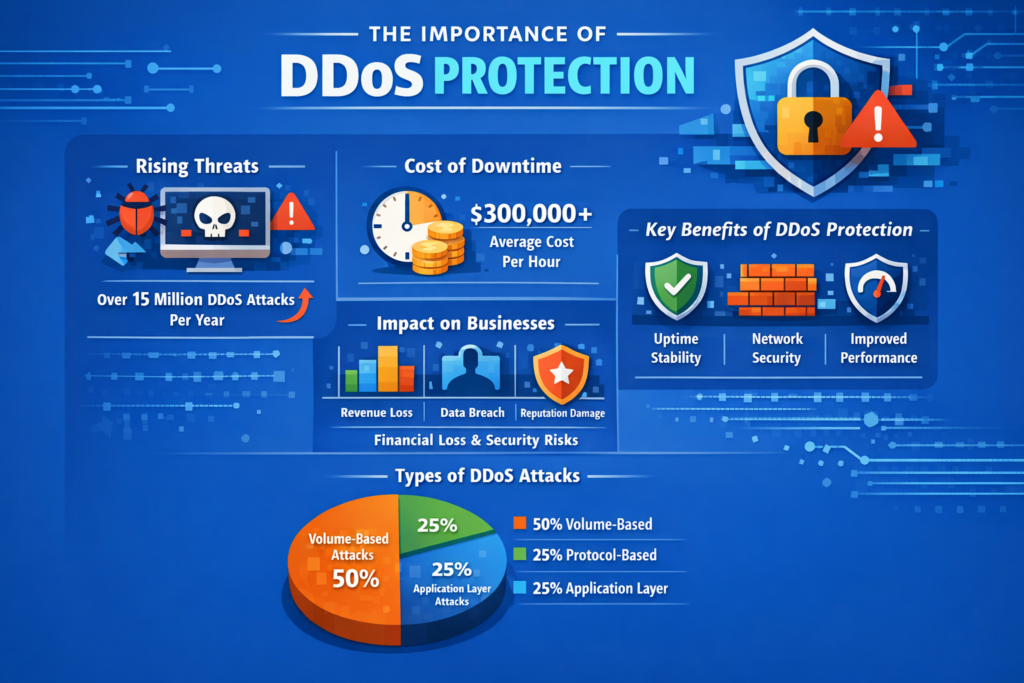
In today’s always-on digital economy, downtime is more than just an inconvenience—it can mean lost revenue, damaged reputation, and frustrated customers. One of the most common and destructive causes of downtime is a DDoS attack (Distributed Denial of Service). These attacks overwhelm a website or server with massive amounts of traffic, making it slow or completely inaccessible to legitimate visitors.
For businesses that rely on their website as a storefront, communication hub, or service platform, even a few minutes of downtime can have costly consequences. Large-scale enterprises, e-commerce stores, SaaS platforms, and even small businesses are all potential targets.
That’s where DDoS protection comes in. It acts like a shield between your hosting infrastructure and the internet, detecting malicious traffic patterns, filtering them out, and ensuring your site stays online and responsive. In 2025, with DDoS attacks becoming more sophisticated and frequent, having robust DDoS protection is not optional—it’s a critical part of responsible web hosting.
2 | Definition in 30 Seconds
DDoS Protection (Web Hosting):
A security measure that detects, mitigates, and blocks distributed denial-of-service attacks, ensuring that a website or server remains accessible to legitimate users by filtering out malicious traffic before it reaches your hosting environment.
It answers four critical hosting security questions:
- How do we prevent our site from going offline due to malicious traffic floods?
- How can we differentiate between legitimate and harmful traffic?
- What tools or services ensure our uptime during an attack?
- How do we protect both performance and reputation during cyber threats?
Think of DDoS protection as a traffic cop for your website—allowing real visitors through while turning away the bad actors trying to clog the roads.
3 | Why DDoS Protection Matters for Web Hosting
| Without DDoS Protection | With DDoS Protection |
| Prolonged downtime during attacks | Continuous uptime and customer access |
| Lost revenue from service interruptions | Maintained sales and service availability |
| Damaged brand trust | Confidence from clients and customers |
| Vulnerability to repeated attacks | Active monitoring and prevention systems |
| High recovery costs post-attack | Reduced risk and minimal disruption |
4 | How DDoS Attacks Work
- Botnet Assembly
- The attacker controls a network of compromised devices (computers, IoT devices, servers).
- The attacker controls a network of compromised devices (computers, IoT devices, servers).
- Traffic Flooding
- The botnet sends massive amounts of traffic to the target server or website.
- The botnet sends massive amounts of traffic to the target server or website.
- Resource Overload
- The target’s bandwidth, CPU, or memory becomes overwhelmed.
- The target’s bandwidth, CPU, or memory becomes overwhelmed.
- Service Disruption
- Legitimate users can’t access the site, causing downtime and potential loss of trust.
- Legitimate users can’t access the site, causing downtime and potential loss of trust.
5 | Types of DDoS Attacks
- Volume-Based Attacks – Flood bandwidth with high-volume traffic (e.g., UDP floods).
- Protocol Attacks – Exploit vulnerabilities in network protocols to consume server resources (e.g., SYN floods).
- Application Layer Attacks – Target specific web applications or services to exhaust server processing capacity (e.g., HTTP GET/POST floods).
6 | Five-Step Blueprint for Effective DDoS Protection
- Use a DDoS-Enabled Hosting Provider
- Select a hosting partner that includes built-in DDoS mitigation services.
- Select a hosting partner that includes built-in DDoS mitigation services.
- Deploy a Content Delivery Network (CDN)
- Distribute traffic across multiple servers globally to absorb and deflect attacks.
- Distribute traffic across multiple servers globally to absorb and deflect attacks.
- Implement Web Application Firewalls (WAF)
- Filter malicious requests before they reach your server.
- Filter malicious requests before they reach your server.
- Enable Traffic Monitoring & Alerts
- Use real-time analytics to spot unusual spikes in traffic patterns.
- Use real-time analytics to spot unusual spikes in traffic patterns.
- Have an Incident Response Plan
- Prepare procedures for identifying, mitigating, and communicating during an attack.
- Prepare procedures for identifying, mitigating, and communicating during an attack.
7 | Common Mistakes (and How to Fix Them)
| Mistake | Negative Effect | Quick Fix |
| Relying only on basic hosting security | Leaves site vulnerable to large-scale attacks | Choose a host with dedicated DDoS protection services |
| No CDN or traffic distribution | All traffic hits a single server point | Use a CDN to spread load and filter requests |
| Ignoring traffic anomalies | Attacks go unnoticed until site crashes | Set up automated monitoring and alerts |
| Not updating security systems | Old configurations may fail against new threats | Regularly update and patch firewalls and WAFs |
| No disaster recovery plan | Extended downtime and poor communication | Create and test an incident response plan |
8 | Advanced DDoS Protection Strategies for 2025
- AI-Powered Threat Detection – Machine learning models that adapt to evolving attack patterns in real time.
- Geo-Blocking – Restrict traffic from countries or regions unrelated to your customer base.
- Rate Limiting – Limit the number of requests per IP to reduce the impact of flooding.
- Anycast Network Routing – Disperse incoming traffic to multiple data centers worldwide.
- Hybrid Protection Models – Combine on-premises security appliances with cloud-based mitigation for layered defense.
9 | Recommended Tool Stack
| Purpose | Tool / Service | Why It Rocks |
| Hosting with Built-in Protection | Cloudflare, Kinsta, SiteGround | Integrates hosting and DDoS mitigation |
| CDN & Traffic Filtering | Akamai, Fastly | Global coverage with rapid traffic distribution |
| WAF Protection | Sucuri, Imperva | Blocks malicious requests and application-level attacks |
| Traffic Monitoring | Datadog, New Relic | Real-time monitoring with alert automation |
| Incident Response | PagerDuty, Opsgenie | Coordinates quick action during active threats |
10 | Case Study: Keeping an E-Commerce Site Online During an Attack
A WebSmarter.com retail client experienced a sudden traffic surge during a holiday sale that turned out to be a DDoS attack.
Before:
- Standard hosting plan with no dedicated DDoS protection.
- Site became slow, then completely unresponsive within 15 minutes.
After WebSmarter’s Hosting & Protection Upgrade:
- Migrated to a hosting provider with integrated DDoS mitigation.
- Implemented Cloudflare CDN with WAF and rate limiting.
- Enabled automated attack alerts and an incident response plan.
Result:
- During a later attempted attack, malicious traffic was filtered in under 60 seconds.
- Legitimate customers experienced no downtime.
- Sales continued uninterrupted, preserving both revenue and customer trust.
11 | How WebSmarter.com Makes DDoS Protection Turnkey
- Hosting Evaluation – Recommend or provide hosting solutions with enterprise-grade DDoS protection.
- Infrastructure Setup – Configure CDNs, WAFs, and monitoring tools for proactive defense.
- Custom Security Rules – Tailor protections to your site’s traffic patterns and business needs.
- Attack Response Planning – Create and train your team on a clear action plan for incidents.
- Continuous Monitoring – Provide 24/7 oversight to detect and mitigate threats in real time.
12 | Wrap-Up: Keeping Your Website Open for Business
DDoS protection is not just a tech add-on—it’s an essential business safeguard in the modern web hosting environment. By blocking malicious traffic before it reaches your server, you protect uptime, revenue, and brand reputation.
With WebSmarter’s expertise, you can implement a layered DDoS defense strategy that keeps your site fast, secure, and open for customers no matter what attackers throw at it.
🚀 Book your Web Hosting & DDoS Protection Consultation today and make downtime a thing of the past.


You must be logged in to post a comment.