

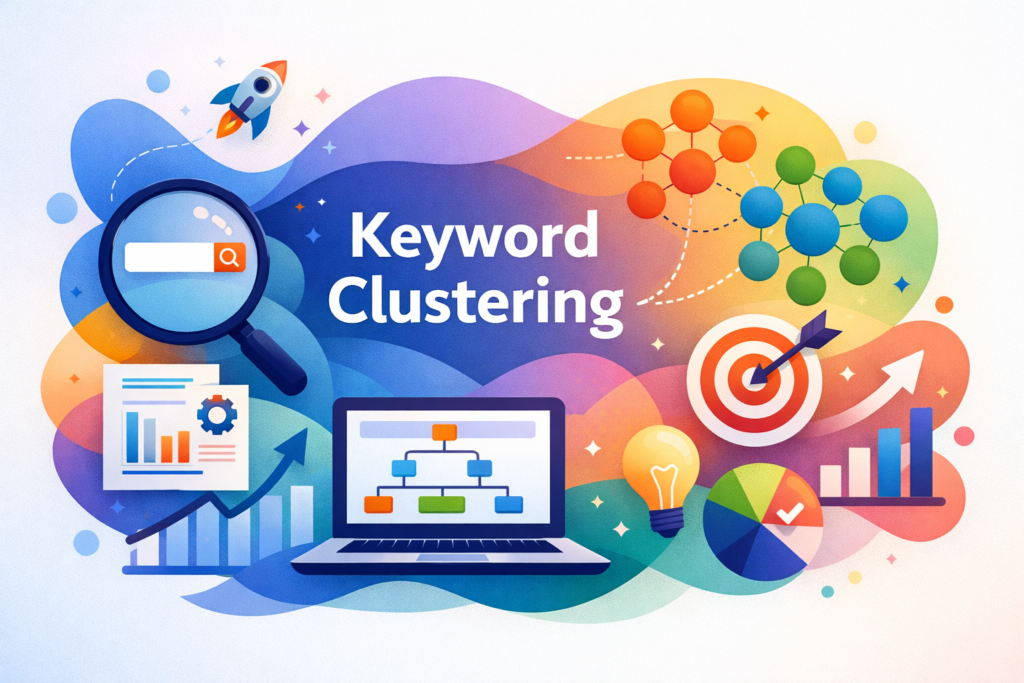
Clustering
Tech Terms Daily – Clustering
Category — A.I. (ARTIFICIAL INTELLIGENCE)
By the WebSmarter.com Tech Tips Talk TV editorial team
1 | Why Today’s Word Matters
In the rapidly expanding world of Artificial Intelligence (AI), the ability to understand, organize, and find patterns in massive amounts of data is critical. Businesses generate and collect enormous datasets from customer transactions, website visits, sensor readings, social media interactions, and more. But data by itself is just raw material—it’s only valuable when you can interpret and use it.
That’s where clustering comes in. Clustering is an AI and machine learning technique that automatically groups similar data points together without requiring pre-labeled categories. It’s an essential part of unsupervised learning, where the system learns from patterns hidden in the data itself.
In 2025, clustering powers everything from customer segmentation in marketing to anomaly detection in cybersecurity and even product recommendations in e-commerce. It helps companies uncover hidden relationships in their data, make data-driven decisions, and deliver personalized user experiences—without manually sorting through millions of records.
2 | Definition in 30 Seconds
Clustering (Artificial Intelligence):
An unsupervised machine learning process that groups data points into clusters based on their similarities, so that items in the same group are more similar to each other than to those in other groups. Clustering helps identify patterns, relationships, and structures in unlabeled datasets.
It answers four critical AI questions:
- How can we automatically group similar data without prior labels?
- What patterns or relationships exist in large datasets?
- How do we segment data for targeted analysis or action?
- How can we detect outliers or anomalies?
Think of clustering as an AI-powered sorting system that organizes messy piles of information into meaningful categories—without anyone telling it what those categories should be.
3 | Why Clustering Matters for AI and Business Applications
| Without Clustering | With Clustering |
| Raw data remains unorganized | Data is grouped into actionable segments |
| Missed insights and patterns | Patterns emerge for strategic decisions |
| One-size-fits-all marketing or services | Personalized experiences and targeting |
| Difficulty detecting anomalies | Faster identification of unusual patterns |
| Slower, manual data analysis | Automated grouping at scale |
4 | Common Clustering Algorithms
- K-Means Clustering – Groups data into a predefined number (k) of clusters by minimizing variance within each cluster.
Best for: Well-separated data and when you know the number of clusters in advance. - Hierarchical Clustering – Builds a hierarchy of clusters either by merging smaller ones (agglomerative) or splitting larger ones (divisive).
Best for: Visualizing relationships between clusters with dendrograms. - DBSCAN (Density-Based Spatial Clustering of Applications with Noise) – Groups closely packed points and marks outliers as noise.
Best for: Data with noise and clusters of varying shapes. - Gaussian Mixture Models (GMM) – Assumes data points are generated from a mixture of Gaussian distributions, allowing soft assignment to clusters.
Best for: Overlapping clusters or when data fits normal distributions.
5 | Five-Step Blueprint for Applying Clustering in AI Projects
- Define the Goal
- Determine what you want to learn from the data: segment customers, detect anomalies, or group products.
- Determine what you want to learn from the data: segment customers, detect anomalies, or group products.
- Prepare the Data
- Clean, normalize, and select features to ensure meaningful clustering results.
- Clean, normalize, and select features to ensure meaningful clustering results.
- Choose the Right Algorithm
- Select based on dataset size, cluster shapes, and whether you know the number of clusters in advance.
- Select based on dataset size, cluster shapes, and whether you know the number of clusters in advance.
- Evaluate and Visualize
- Use metrics like silhouette score or Davies–Bouldin index to assess performance; visualize clusters with scatter plots or t-SNE.
- Use metrics like silhouette score or Davies–Bouldin index to assess performance; visualize clusters with scatter plots or t-SNE.
- Integrate and Act
- Apply insights to business strategies—personalized campaigns, optimized inventory, fraud detection, or other operational improvements.
- Apply insights to business strategies—personalized campaigns, optimized inventory, fraud detection, or other operational improvements.
6 | Common Mistakes (and How to Fix Them)
| Mistake | Negative Effect | Quick Fix |
| Not scaling or normalizing data | Skewed clustering results | Standardize features before running algorithms |
| Choosing the wrong number of clusters | Poor segmentation accuracy | Use the elbow method or silhouette analysis |
| Overfitting with too many clusters | Loss of general insights | Aim for clusters that balance detail and interpretability |
| Ignoring outliers | Distorted cluster assignments | Use algorithms like DBSCAN or preprocess to remove noise |
| No business context for results | Insights that can’t be acted upon | Align clustering with clear objectives and KPIs |
7 | Advanced Clustering Strategies for 2025
- AI-Driven Feature Engineering – Use deep learning to automatically extract meaningful features before clustering.
- Hybrid Models – Combine clustering with supervised learning to create labeled datasets for prediction models.
- Streaming Clustering – Apply clustering to real-time data streams for live monitoring and alert systems.
- High-Dimensional Data Clustering – Use dimensionality reduction (PCA, t-SNE, UMAP) before clustering for complex datasets.
- Explainable Clustering – Implement tools that make cluster decisions interpretable to non-technical stakeholders.
8 | Recommended Tool Stack for Clustering
| Purpose | Tool / Service | Why It Rocks |
| General ML Frameworks | Scikit-learn, TensorFlow | Robust algorithms and flexibility |
| Visualization | Matplotlib, Seaborn, Plotly | Clear visual insights into clusters |
| Big Data Clustering | Apache Spark MLlib | Scales clustering to massive datasets |
| Dimensionality Reduction | PCA in Scikit-learn, t-SNE in TensorFlow | Prepares complex data for clustering |
| Business Integration | Power BI, Tableau | Connects clustering insights to decision-makers |
9 | Case Study: Using Clustering to Drive Personalization
A WebSmarter.com e-commerce client wanted to increase customer retention and average order value. They had large volumes of purchase and browsing data but no clear understanding of their customer segments.
Before:
- All customers received the same promotions.
- Low engagement with marketing emails.
- Limited insight into customer preferences.
After WebSmarter’s Clustering Implementation:
- Applied K-Means clustering to group customers by purchase frequency, average spend, and product categories.
- Identified four distinct customer segments: high spenders, frequent bargain hunters, seasonal buyers, and one-time purchasers.
- Tailored campaigns for each group: exclusive offers for high spenders, seasonal reminders, and targeted discounts for bargain hunters.
Result:
- Email open rates increased by 36%.
- Repeat purchases grew by 22% in six months.
- Average order value rose by 15%.
10 | How WebSmarter.com Makes Clustering Turnkey
- Business-First Data Strategy – Identify opportunities where clustering delivers measurable ROI.
- Data Preparation – Clean, normalize, and engineer features for optimal AI performance.
- Algorithm Selection & Testing – Match your business needs with the right clustering approach.
- Insight Visualization – Present findings in easy-to-understand dashboards for action.
- Ongoing Optimization – Continuously refine models as new data and objectives emerge.
11 | Wrap-Up: Turning Chaos into Clarity
Clustering is one of AI’s most versatile tools for transforming large, unlabeled datasets into clear, actionable insights. It organizes information in ways that make it easier for businesses to segment audiences, detect patterns, and personalize experiences.
With WebSmarter’s expertise, you can leverage clustering to better understand your customers, optimize operations, and uncover opportunities hidden in your data—helping you stay competitive in a data-driven world.
🚀 Book your AI Data Strategy & Clustering Consultation today and start unlocking the value of your data.
You must be logged in to post a comment.