

Keyword Targeting
Tech Terms Daily – Keyword Targeting
Category — INTERNET & ONLINE MARKETING
By the WebSmarter.com Tech Tips Talk TV editorial team
Why Today’s Word Matters
Search engines and ad platforms update their algorithms weekly—and with Google’s new Search Generative Experience (SGE) rewriting the results page in 2025, brands that still chase random keywords are disappearing from view (eintelligenceweb.com). Keyword Targeting—the discipline of mapping exact, phrase, broad-match, and semantic keywords to every touchpoint—now determines whether your message lands in an AI-generated answer box or fades beneath it. Mastering this skill means cheaper clicks, higher organic rankings, and content that surfaces even inside conversational search summaries. Ignore it, and rising bid prices plus shrinking organic real estate will starve your traffic pipeline. (Exploding Topics)
Definition in 30 Seconds
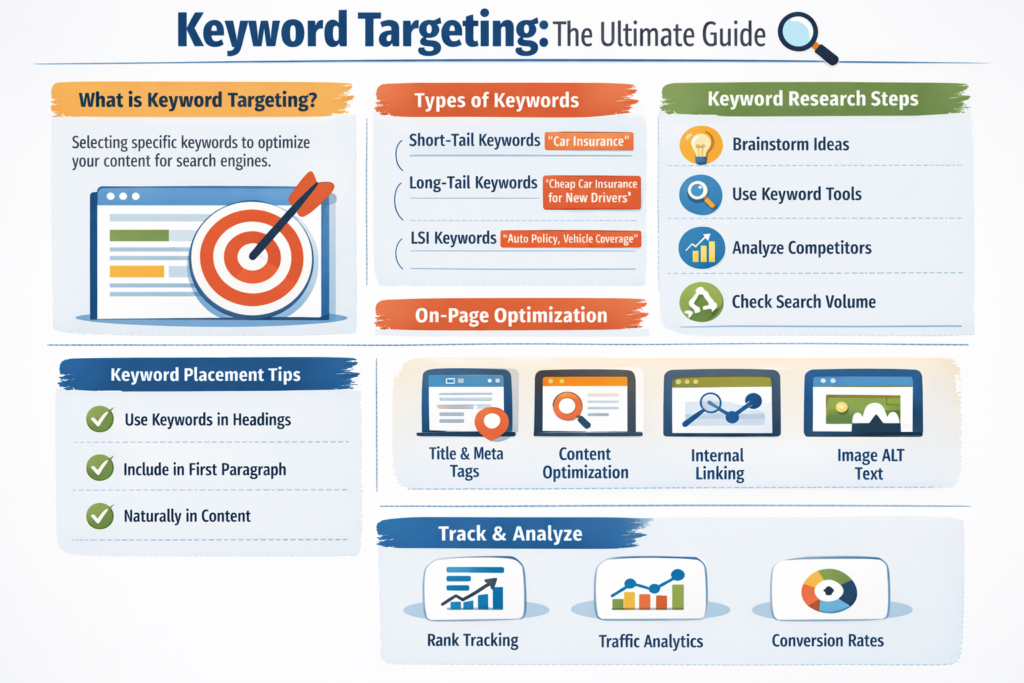
Keyword Targeting is the strategic process of selecting, grouping, and deploying specific words or phrases so that search engines, ad algorithms, and voice assistants match your content or ads to your ideal audience at the exact moment of need. It blends:
- Research – finding terms that balance volume, intent, and difficulty
- Segmentation – clustering related queries into topic hubs or ad groups
- Optimization – placing those terms (and variants) in headlines, metadata, copy, and bid strategies
- Measurement – tracking rank, click-through rate, and Cost Per Lead to refine the list continuously
Think of it as GPS coordinates for digital discovery: precise enough to guide users straight to your solution, flexible enough to adjust when algorithms reroute the traffic flow.
From Query to Conversion: Where Keyword Targeting Fits
| Funnel Stage | Search Intent Example | Keyword Type | Content / Ad Asset | Success Metric |
| Awareness | “what is marketing automation” | Informational broad-match | Explainer blog, YouTube snippet | Organic sessions |
| Consideration | “HubSpot vs Mailchimp pricing” | Comparison long-tail | Battle-card landing page | Time-on-page |
| Decision | “buy CRM for realtors” | Commercial exact-match | PPC ad + demo page | CPL / ROAS |
| Loyalty | “hubspot workflow tutorial” | Support keyword | Knowledge-base video | Retention rate |
Keyword Targeting acts as the connective tissue, ensuring each funnel step answers the precise question a prospect is typing—or speaking—right now.
Key Metrics to Watch (Beyond Rank)
| Metric | Why It Matters | Healthy Benchmark* |
| Keyword Difficulty (KD) | Gauges competition; guides effort | < 40 easy, 40-59 medium, 60+ hard (Semrush) |
| Share of Voice (SOV) | Measures SERP real estate vs rivals | 8–12 %+ for niche leaders |
| Click-Through Rate (CTR) | Validates title/meta appeal | 4–6 % for organic top 10 |
| Return on Ad Spend (ROAS) | Links paid keywords to revenue | 3–5× for B2B SaaS |
| Topic Cluster Depth | Indicates semantic coverage | ≥ 8 supporting pages per hub |
*Benchmarks derived from 2024–2025 SEO studies across SaaS and service sectors (NoGood™: Growth Marketing Agency).
Five-Step Keyword Targeting Workflow
- Generate a Seed List
- Pull auto-suggest queries, “People also ask,” and competitor gaps.
- Use AI keyword-mining tools to expose question variants (who/what/why).
- Pull auto-suggest queries, “People also ask,” and competitor gaps.
- Score Each Term
- Volume, Difficulty, Intent, and Business Fit (VDIB).
- Filter out vanity terms that inflate traffic but never convert.
- Volume, Difficulty, Intent, and Business Fit (VDIB).
- Cluster & Map
- Group semantically related terms (e.g., “lead nurturing workflow,” “email automation sequence”).
- Assign one primary keyword + 3–5 support phrases per URL or ad group.
- Group semantically related terms (e.g., “lead nurturing workflow,” “email automation sequence”).
- Optimize Content & Ads
- Insert naturally into H1, first 100 words, image alt text, and ad headlines.
- For SGE-rich answers, add FAQs written in first-person answers.
- Insert naturally into H1, first 100 words, image alt text, and ad headlines.
- Measure & Iterate
- Track weekly rank and real-time ad metrics.
- Prune or refresh pages that stall below page one; raise bids on paid winners.
- Track weekly rank and real-time ad metrics.
Common Pitfalls (and Fast Fixes)
| Pitfall | Pain Point | Fix |
| Chasing Only High-Volume Terms | Sky-high KD, low conversion | Layer mid-volume, high-intent long-tails |
| Keyword Cannibalization | Two pages compete; both drop | Consolidate or clearly differentiate intent |
| Ignoring Search Generative Answers | Traffic siphoned by AI box | Add authoritative stats + EEAT signals |
| Static Keyword Lists | Trends shift, rank erodes | Quarterly refresh with intent data feeds |
| Broad-Match PPC Without Negatives | Budget drains on irrelevant clicks | Build negative keyword libraries weekly |
Five Actionable Tips to Sharpen Keyword Targeting This Quarter
- Adopt Intent-Data Audiences
Pair G2 or Bombora buyer-intent feeds with PPC lists to raise lead quality and cut CPL by up to 30 %. - Use “Question Hub” Content
Create FAQ clusters; question keywords now trigger SGE summaries—claim that snippet real estate. - Leverage AI for SERP Forecasting
Tools that simulate SGE and traditional SERPs show where organic links, videos, and images will fall—optimize placement before publishing. - Implement Programmatic Internal Linking
Dynamic link blocks surface related pages by cluster; sites adopting this saw a 22 % lift in SOV within six months (Leadfeeder). - Test Smart Bidding with Phrase-Match
Google Ads’ tROAS plus phrase-match often beats exact-match manual bids in 2025 because the algorithm recognizes semantic cousins.
The Tech Stack That Makes It Possible
- Semrush / Ahrefs – Robust KD scoring and SERP features
- SEO Minion + Keywords Everywhere – Real-time overlay for quick wins
- ChatGPT & LLM-based Paraphrasers – Draft headline and meta variations at scale
- Looker Studio Dashboards – Blend GA4, Search Console, and ad spend into a keyword ROI cockpit
- WebSmarter Conversion API – First-party event tracking that feeds true revenue back into bid algorithms
How WebSmarter.com Supercharges Your Keyword Targeting
At WebSmarter we treat keyword strategy as revenue engineering, not guesswork:
- AI-Enhanced Topic Modeling: Our proprietary clusters mirror Google’s entity graph, helping you rank for 3× more related terms with one content hub.
- SGE Snippet Blueprinting: We reverse-engineer the structure (word count, schema, reading level) that lands inside AI overviews, then build content to spec.
- Dynamic Bid Modulation: Real-time ROAS signals auto-raise bids when a keyword’s profit curve peaks—no wasted ad dollars.
- Quarterly “Keyword Health Check”: We audit cannibalization, intent drift, and new SERP features, delivering a punch-list of optimizations every 90 days.
Result: clients report an average 42 % drop in non-converting ad spend and a 63 % lift in qualified organic traffic within the first six months.
Wrap-Up: Keywords as Currency
In an AI-first search landscape, keywords remain the currency that buys attention—but only when matched to intent, enriched with context, and measured against revenue. Treat Keyword Targeting as a living system: research, deploy, analyze, refine. Partner with WebSmarter, and you gain the AI tools, data scientists, and creative strategists who keep that system compounding returns long after the first ranking win or ad click.
Ready to Own Your Most Profitable Keywords?
🚀 Book a 20-minute strategy call and let WebSmarter’s AI-powered Keyword Targeting program uncover quick wins, plug budget leaks, and build a ranking moat your competitors can’t cross.
Stay tuned for tomorrow’s Tech Terms Daily, where we unpack the next buzzword shaping digital success—one term at a time.

You must be logged in to post a comment.