

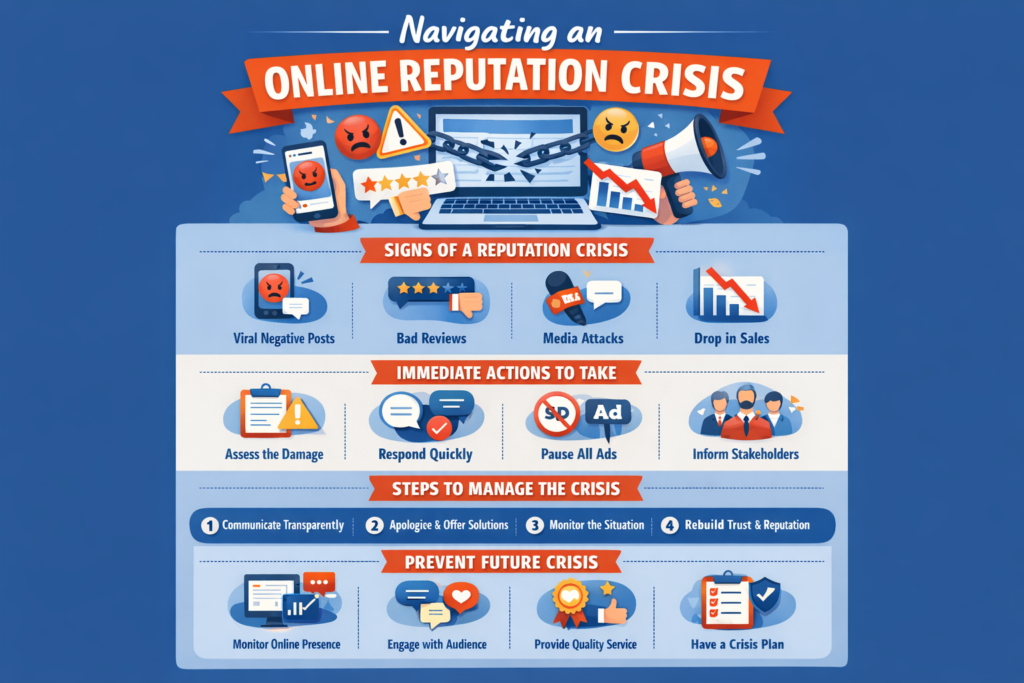
Online Reputation Crisis
Tech Terms Daily – Online Reputation Crisis
Category — Online Reputation
By the WebSmarter.com Tech Tips Talk TV editorial team
1. Why Today’s Word Matters
In 2025 a single Reddit thread about a mislabeled ingredient wiped $2.3 billion from a global snack brand’s market cap in 48 hours. False or exaggerated? It didn’t matter—algorithms pushed the outrage; customers, investors, and regulators followed. An online reputation crisis can erupt from a tweet, a data leak, or a viral video and spread faster than any press release can catch. Studies show that 87 % of consumers will abandon a purchase if the first page of Google reveals negative news, and B2B buyers behave the same. If you don’t know how to detect, contain, and reverse a digital firestorm, years of brand equity can disappear overnight.
2. Definition in 30 Seconds
An online reputation crisis is a sudden, large-scale surge of negative digital content—posts, reviews, articles, or videos—that reaches critical visibility, threatens stakeholder trust, and demands immediate multichannel response. It is defined by three traits:
- Velocity – spikes in mentions or sentiment within hours;
- Amplification – picked up by mainstream media, influencers, or search-engine top results;
- Material Risk – measurable impact on revenue, stock price, legal exposure, or public safety.
Unlike routine criticism, a crisis overwhelms normal social-media or customer-service workflows and needs an executive-level playbook.
3. The Crisis Curve – Four Stages & Response Goals
| Stage | Window | Stakeholder Psychology | Brand Objective |
| Ignition | 0-3 hrs | Shock, curiosity | Detect fast, gather facts |
| Flashpoint | 3-24 hrs | Anger, share frenzy | Contain narrative, acknowledge publicly |
| Echo | 1-7 days | Media analysis, regulator alerts | Provide evidence, corrective action |
| Recovery | 1-90 days | Forgetting or forgiveness | Rebuild trust, own SERP, publish learnings |
Rule of thumb: You can’t outrun Ignition, but you can shorten Flashpoint and define Echo.
4. Root Causes & Early Warning Signs
| Category | Triggers | Red-Flag Metrics |
| Operational Failures | Data breach, product defect, service outage | Sudden > 500 % spike in brand-name + “scam” searches |
| Ethical Missteps | Discriminatory remark, greenwashing claim | Hashtag creation or trending in last 60 minutes |
| Third-Party Shockwaves | Supplier scandal, influencer misconduct | Backlink influx from news domains |
| Fake/Coordinated Attacks | Competitor smear, botnets | High mention velocity but low unique user ratio |
Deploy 24/7 social-listening dashboards and Google SERP diff tracking to surface anomalies within minutes.
5. Step-by-Step Blueprint: Crisis Response in the First 24 Hours
Step 1 – Activate the War Room
- Cross-functional team: Comms, Legal, Product, Security, and Support.
- Single Slack/Teams channel + cloud doc for real-time fact logging.
Step 2 – Gather Facts & Verifiable Data
- Confirm incident scope; pull logs, timestamps, customer counts.
- Classify assertions: true, partly true, false, unknown.
Step 3 – Draft the Holding Statement (≤ 150 words)
- Acknowledgment – “We are aware…”
- Empathy – “We understand your concern…”
- Action – “We’re investigating and will update within X hours.”
Publish on owned channels (website banner, social pins) within one hour of confirmation.
Step 4 – Secure Digital Real Estate
- Register crisis-related hashtags and domains to prevent impersonation.
- Update Google Business Profile & Apple Maps with official notice.
Step 5 – Engage Priority Stakeholders Privately
- Direct emails/calls to top clients, partners, investors with transparent details.
- Offer hotlines or dedicated support forms.
Step 6 – Monitor & Adapt Every 60 Minutes
- Sentiment score, share of voice, media pick-ups.
- Escalate to legal/regulatory bodies if data privacy or safety impacted.
6. Common Pitfalls & Fast Fixes
| Pitfall | Consequence | Fix |
| Silence or “No Comment” | Vacuum filled by speculation | Issue holding statement fast |
| Blame Shifting | Perceived deflection | Own the issue first, investigate later |
| Deleting Posts | Streisand effect, archive screenshots | Leave originals, add context reply |
| One-Channel Response | Audience fragmentation | Cross-post synced messages in web, email, social |
| Over-Promising | Future legal exposure | State intent, not guarantees you can’t keep |
7. Metrics to Measure Reputation Recovery
| KPI | Crisis Peak | Target by Day 30 | Tool |
| Negative Sentiment % | Example 78 % | < 25 % | Brandwatch |
| First-Page Negative SERP Links | 6 /10 | ≤ 2 /10 | Ahrefs |
| Share of Voice vs. Competitors | –30 % | Return to baseline | Meltwater |
| Churn/Refund Rate | +45 % | +5 % | CRM/Stripe |
| Net Promoter Score | –18 | Pre-crisis average | SurveyMonkey |
8. Real-World Case Study
A tele-health startup discovered a misconfigured S3 bucket exposing 20 000 user records. Hacker News thread hit front page; BBC picked up story within four hours.
WebSmarter Actions:
- Ignition: Detected 1 200 % spike in “{brand}+privacy” mentions; activated war room.
- Flashpoint (3 hrs): Published holding statement, took app offline, rotated keys.
- Day 1 Press Brief: CEO video apology + timeline; offered free ID-protection.
- SEO Shield: Deployed 15 expert-authored security blogs, pushed to Google News.
- Echo management: Weekly progress updates; third-party audit certificates.
Results (90 days)
- First-page negative links dropped from 8 to 1.
- Monthly sign-ups recovered to 112 % of pre-crisis level.
- NPS rebounded from 14 to 38.
9. How WebSmarter.com Prevents & Resolves Online Reputation Crises
- 24/7 Reputation Radar – AI that flags sentiment anomalies < 5 minutes.
- Crisis Playbook Build-Out – Customized runbooks, contact trees, holding-statement templates.
- Rapid-Response Content Hub – Deploys evidence-based blogs, FAQs, and expert interviews within hours.
- SERP Armor Technology – Authority-site publishing + schema to replace negative links.
- Stakeholder Comms Suite – Email sequences, webinar scripts, investor decks ready to launch.
- Post-Mortem & Policy Upgrade – Root-cause workshops and SOP revisions, ensuring lightning-faster response next time.
Clients typically cut negative-sentiment duration by 60 % and regain pre-crisis conversion rates within a single quarter.
10. Key Takeaways
- An online reputation crisis combines speed, scale, and real business risk; seconds matter.
- Four stages: Ignition, Flashpoint, Echo, Recovery—each demands specific actions.
- Early warning via social listening, transparent holding statements, and multi-channel communication are non-negotiable.
- Track sentiment, SERP control, churn, and NPS to prove recovery.
- WebSmarter.com equips brands with radar, playbooks, content armor, and post-mortem upgrades to turn crises into comeback stories.
Conclusion
The digital world never sleeps, and neither does public scrutiny. A single misstep—real or rumored—can ignite an online reputation crisis that rewrites your brand narrative in hours. Preparedness is profit; delay is disaster. Schedule your complimentary Crisis-Readiness & Reputation Audit with WebSmarter.com and transform uncertainty into unshakable trust—before the next headline hits.

You must be logged in to post a comment.