

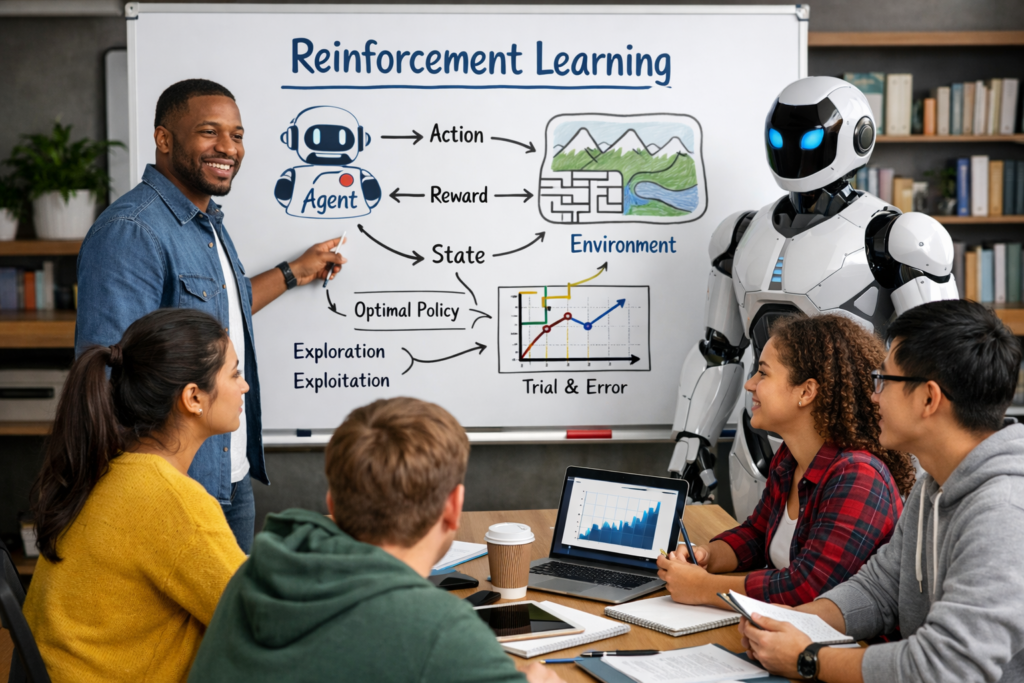
Reinforcement Learning
Tech Terms Daily – Reinforcement Learning
Category — A.I. (ARTIFICIAL INTELLIGENCE)
By the WebSmarter.com Tech Tips Talk TV editorial team
1 | Why Today’s Word Matters
Artificial Intelligence is no longer just about recognizing patterns or predicting outcomes—it’s about learning how to make decisions in dynamic, often unpredictable environments. That’s where Reinforcement Learning (RL) shines.
Reinforcement Learning is the AI technique behind breakthroughs in robotics, autonomous vehicles, advanced game-playing AIs, and even supply chain optimization. Unlike supervised learning, where models learn from labeled examples, RL models learn through trial and error—making decisions, receiving feedback, and adjusting strategies over time.
In 2025, RL is becoming increasingly valuable for businesses seeking to optimize processes that involve sequences of decisions: from personalized recommendations that adapt to user behavior, to automated trading systems that adjust strategies in real time. Understanding RL is crucial if you want to explore AI solutions that can adapt, improve, and self-optimize in complex, real-world scenarios.
2 | Definition in 30 Seconds
Reinforcement Learning (Artificial Intelligence):
A machine learning approach where an agent learns to make decisions by interacting with an environment, receiving feedback in the form of rewards or penalties, and refining its strategy to maximize long-term cumulative rewards.
It answers four critical AI development questions:
- How can AI learn from experience without explicit instructions for every situation?
- How do we create systems that improve decision-making over time?
- How can an AI adapt strategies to changing conditions?
- What’s the best way to optimize actions for long-term benefits, not just immediate gains?
Think of Reinforcement Learning as teaching a dog new tricks—but instead of treats, the AI gets rewards for making better decisions over time.
3 | Why Reinforcement Learning Is Important
| Without RL | With RL |
| Static decision-making, limited adaptability | Adaptive learning from interaction and feedback |
| AI struggles in dynamic environments | AI thrives in changing, uncertain conditions |
| Hard-coded rules that can’t evolve | Flexible strategies that self-improve |
| Limited optimization in multi-step processes | Optimizes for long-term outcomes, not just short-term wins |
4 | Core Concepts in Reinforcement Learning
- Agent – The decision-maker (e.g., AI program).
- Environment – The system or world the agent interacts with.
- State – The current situation of the environment.
- Action – A decision the agent makes.
- Reward – Feedback given to the agent after taking an action.
- Policy – The strategy the agent uses to choose actions.
- Episode – A complete sequence of states, actions, and rewards until an end condition is reached.
5 | Five-Step Blueprint for Implementing Reinforcement Learning
- Define the Problem & Environment
- Decide what the agent will learn to optimize, and set up a simulation or environment for training.
- Decide what the agent will learn to optimize, and set up a simulation or environment for training.
- Choose the Right RL Algorithm
- Popular algorithms include Q-Learning, Deep Q-Networks (DQN), and Policy Gradient methods.
- Popular algorithms include Q-Learning, Deep Q-Networks (DQN), and Policy Gradient methods.
- Set Rewards and Penalties
- Design a reward system that aligns with your desired outcomes—avoiding “reward hacking” where the AI finds shortcuts.
- Design a reward system that aligns with your desired outcomes—avoiding “reward hacking” where the AI finds shortcuts.
- Train Through Iteration
- Let the agent interact, experiment, and learn over thousands (or millions) of iterations.
- Let the agent interact, experiment, and learn over thousands (or millions) of iterations.
- Test and Refine
- Evaluate performance in real-world or simulated conditions, adjusting rewards, policies, or environment complexity as needed.
- Evaluate performance in real-world or simulated conditions, adjusting rewards, policies, or environment complexity as needed.
6 | Common Mistakes (and How to Fix Them)
| Mistake | Negative Effect | Quick Fix |
| Poorly designed reward system | AI exploits loopholes, misses the real goal | Align rewards with business objectives and monitor for unintended behavior |
| Training in unrealistic environments | AI fails in real-world conditions | Simulate conditions as close to reality as possible |
| Too few training episodes | Weak or inconsistent performance | Increase training iterations and adjust learning rates |
| Ignoring exploration vs. exploitation balance | AI gets stuck in suboptimal strategies | Use techniques like ε-greedy policies to maintain exploration |
| Overfitting to training environment | Poor adaptability to new situations | Test in multiple varied environments before deployment |
7 | Advanced Reinforcement Learning Strategies for 2025
- Deep Reinforcement Learning (DRL) – Combines RL with deep neural networks for complex, high-dimensional problems.
- Multi-Agent RL – Multiple agents learning together or competing, useful for simulations like market modeling.
- Model-Based RL – Uses predictive models of the environment to speed up learning.
- Transfer Learning in RL – Reuse learned policies in new but related environments.
- Safe RL – Ensures the agent avoids catastrophic actions during learning and deployment.
8 | Recommended Tool Stack for Reinforcement Learning Development
| Purpose | Tool / Service | Why It Rocks |
| RL Framework | OpenAI Gym | Standardized environments for RL experiments |
| Deep RL Library | Stable Baselines3, RLlib | Ready-to-use RL algorithms and tools |
| Simulation Platforms | Unity ML-Agents, CARLA | Build complex, realistic training environments |
| Data Logging & Analysis | Weights & Biases, MLflow | Track training metrics, visualize policies |
| Cloud Compute | AWS SageMaker, Google Cloud AI | Scales RL training with high-performance compute |
9 | Case Study: Optimizing Warehouse Robotics with RL
A WebSmarter.com manufacturing client wanted to improve the efficiency of warehouse robots moving products from storage to shipping.
Before:
- Robots followed pre-programmed routes, causing congestion in high-traffic areas.
- No adaptability to shifting inventory layouts or rush orders.
After WebSmarter’s RL Implementation:
- Created a simulated warehouse environment in Unity ML-Agents.
- Designed a reward system prioritizing speed, energy efficiency, and collision avoidance.
- Trained the RL agent over millions of simulations to optimize routing dynamically.
Result:
- Average delivery time reduced by 23%.
- Energy consumption dropped by 15%.
- System adapted automatically to new warehouse layouts without manual reprogramming.
10 | How WebSmarter.com Makes RL Turnkey
- Problem Scoping – Identify opportunities where RL can outperform traditional methods.
- Custom Environment Design – Build realistic simulations for safe and effective training.
- Algorithm Selection & Tuning – Choose and optimize RL methods for your specific goals.
- Integration with Existing Systems – Deploy RL models into your operational tech stack.
- Performance Monitoring – Continuously track and refine models for long-term success.
11 | Wrap-Up: Teaching AI to Learn from Experience
Reinforcement Learning is one of the most exciting and versatile areas of AI, capable of creating systems that continuously improve without explicit step-by-step programming. Whether it’s guiding robots, optimizing logistics, or personalizing digital experiences, RL gives businesses the power to adapt faster than ever before.
With WebSmarter’s expertise, you can unlock RL’s potential—designing agents that make smarter decisions, adapt to changing conditions, and deliver measurable results.
🚀 Book your Reinforcement Learning Strategy Session today and start building AI that learns like a human—only faster.
You must be logged in to post a comment.