

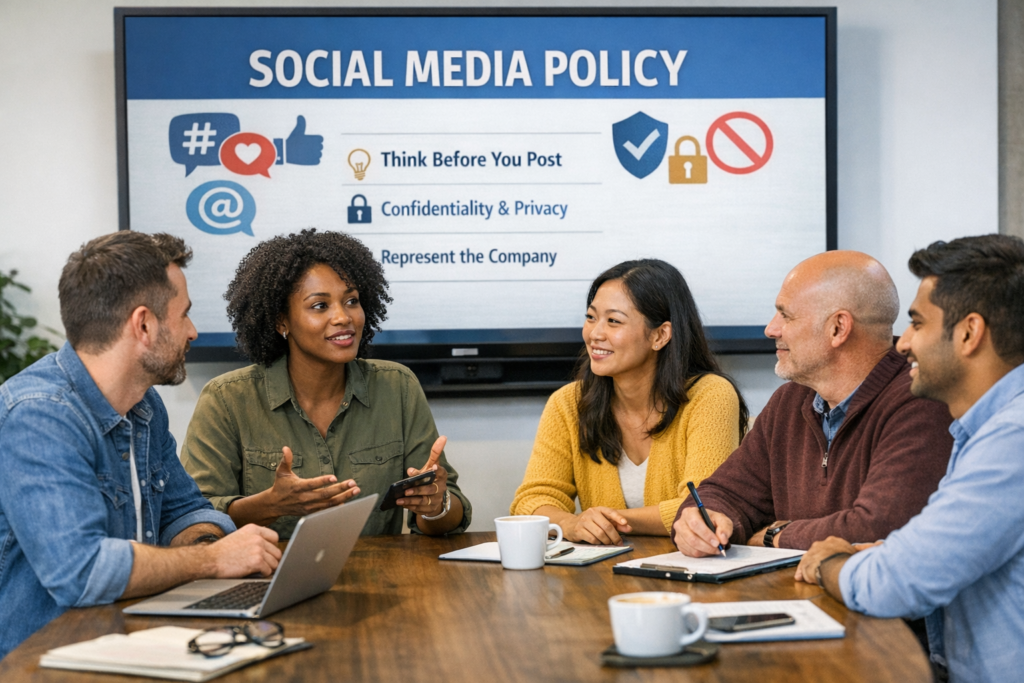
Social Media Policy
Tech Terms Daily – Social Media Policy
Category — SOCIAL MEDIA MARKETING
By the WebSmarter.com Tech Tips Talk TV editorial team
1 | Why Today’s Word Matters
One rogue TikTok, a customer‐service slip in X’s frenetic reply threads, or an intern’s “private” Instagram Story can explode into a headline-level crisis within minutes. According to Deloitte’s 2025 Global Risk Survey, 72 % of stakeholders decide brand trust based on how companies behave on social channels—and that includes every employee account listed in a bio, retweeting a meme, or commenting on a viral post. Meanwhile, new EU Digital Services Act (DSA) rules and FTC disclosure crack-downs expose brands to fines for influencer missteps and dark-pattern CTAs.
A well-crafted Social Media Policy transforms this minefield into a playbook for brand safety, employee advocacy, and compliance. Organizations with an enforced policy report:
- –46 % reduction in social-media related incidents (Hootsuite/Altimeter, 2024)
- +33 % faster crisis resolution when issues do arise, thanks to predefined workflows
- 2× higher employee‐generated reach because staff know what—and where—they’re allowed to share
Treat a Social Media Policy as your brand’s living constitution online, and you’ll empower creative, compliant engagement. Ignore it, and you’ll discover the cost of silence only after a tweetstorm hits your revenue.
2 | Definition in 30 Seconds
A Social Media Policy is a formal set of guidelines that governs how a company’s brand channels, employees, and third-party partners create, publish, engage with, and report content on social networks. It typically covers:
- Voice & Tone – brand personality, grammar rules, emoji use
- Content Guardrails – prohibited topics, IP, political statements
- Regulatory Compliance – FTC #ad rules, GDPR privacy, accessibility
- Security & Crisis Protocols – account access, password hygiene, incident escalation
- Employee Advocacy & Personal Accounts – what’s permissible, disclaimers, hashtags
Think of it as the rulebook + playbook + safety net for everything happening on feeds, stories, and DMs—whether posted at HQ or on a sales rep’s phone.
3 | Core Sections of a Modern Policy
| Section | Minimum Contents (2025 standards) |
| Purpose & Scope | Covers corporate, employee, agency, influencer, and user‐generated content |
| Brand Voice | Style guide, approved emojis, inclusive language checklist |
| Content Do’s/Don’ts | No-go topics, fact-checking steps, citation format |
| Disclosure Rules | #ad, “Employee of”, affiliate tags, SEC Reg FD in investor contexts |
| Legal & Privacy | Copyright, trademarks, GDPR/CCPA data handling |
| Security | 2FA mandate, role-based permissions, offboarding procedures |
| Crisis Response | 5-stage escalation ladder, spokesperson roster, holding statement templates |
| Monitoring & Reporting | KPIs, social listening tools, breach-report channels |
4 | Key Metrics That Signal Policy Success
| Metric | Why It Matters | Healthy Benchmark* |
| Policy Adoption Rate | Share of staff who passed training | ≥ 90 % within 60 days onboarding |
| Social Incident Frequency | Public‐facing missteps per quarter | < 1 major, < 3 minor |
| Mean Time to Contain (MTTC) | Speed from incident detect → public response | < 2 hrs tier-1 issues |
| Employee Advocacy Reach Lift | Earned impressions from staff posts | +15 – 25 % QoQ after rollout |
| Regulatory Violation Count | FTC/DSA/ASA notices received | Zero |
*Benchmarks from WebSmarter compliance audits, 2024–2025
5 | Five-Step Blueprint to Draft & Deploy a High-Impact Policy
1. Assemble a Cross-Functional Task Force
Include Marketing, HR, Legal, IT Security, PR, and frontline staff. Diversity ensures guidelines are realistic and enforceable.
2. Map Risk vs. Opportunity
Audit past incidents, platform footprints, and upcoming campaigns. Prioritize rules around high-risk areas (e.g., healthcare HIPAA, financial disclosures).
3. Codify Guidelines in Plain Language
Aim for Flesch-Kincaid grade 8–10. Replace legalese (“herein”) with actionable verbs (“Do”, “Avoid”). Add real screenshots: “✅ Right”, “🚫 Wrong”.
4. Train, Test, Certify
Interactive e-learning modules with scenario quizzes. Require pass marks before granting publishing permissions. Refresh annually or at every major platform policy change.
5. Monitor & Iterate
Use social listening (Brandwatch), access logs (Okta), and quarterly tabletop crisis drills to refine rules. Publish changelogs like software release notes.
6 | Common Pitfalls (and Quick Fixes)
| Pitfall | Pain Point | Rapid Remedy |
| Policy PDF lost on intranet | Low awareness, accidental violations | Host in Notion/Confluence, link in Slack header |
| One-size-fits-all tone | Stifles TikTok creativity | Add platform-specific voice nuances (“Witty fun on TikTok, authoritative on LinkedIn”) |
| No clear crisis chain-of-command | Confusion = viral silence | Embed escalation tree with names, phone, backup |
| Forget contractors & agencies | Third-party posts still your liability | Bind via SOW, require same training |
| Static policy | Outdated with new features (Reels, Threads) | Quarterly review calendar invite |
7 | Five Advanced Tactics for 2025
- AI Policy Copilot
GPT-based internal bot answers “Can I post this meme?” queries and scans drafts for banned language before they go live. - Zero-Trust Social Access
Passwordless (passkey) logins + device attestation ensure ex-employees or phished accounts can’t reach brand handles. - Dynamic Disclosure Tags
CMS auto-appends correct #ad/#affiliate/#partner based on campaign metadata—no human forgetfulness. - Sentiment-Triggered Escalation
R-shiny or Looker dashboards use NLP to flag negative spike; Slackbot pings crisis channel with suggested responses. - Policy Gamification
Quarterly Kahoot! quizzes award points; leaderboard keeps guidelines top-of-mind and fun.
8 | Recommended Tool Stack
| Need | Tool | Highlight |
| Policy Hosting & Version | Confluence, Notion, Slite | Inline comment & change history |
| Training & Certification | Lessonly, Docebo, TalentLMS | Scenario branching quizzes |
| Draft Pre-Flight Checks | GrammarlyGO, ChatGPT Policy Prompt | Flag risky terms, missing disclosures |
| Social Access Mgmt | Sprout, Hootsuite, Brandwatch Influence | Role-based permissions & audit logs |
| Sentiment & Crisis Alert | Brandwatch, Talkwalker, SentiOne | Real-time negative sentiment thresholds |
9 | How WebSmarter.com Turns Policy into Performance
- Risk & Opportunity Audit – 72-hour sprint identifies gaps, past near-misses, and platform expansion plans.
- Custom Policy Draft – Legal + creative writers craft tone-specific, regulation-compliant guidelines (avg. 18-page doc with visual examples).
- Interactive Training Portal – SCORM-compliant modules, quiz bank, and automated certificates plugged into HRIS.
- AI Policy Copilot Setup – We train a private GPT on your rules; employees get instant Slack/Teams answers 24 / 7.
- Quarterly Drill & Update – Run mock crises, update policy for new features, produce board-ready compliance reports.
Clients slash social-incident frequency –58 % and boost employee advocacy reach +31 % within six months.
10 | Wrap-Up: Rules That Unlock Results
A Social Media Policy isn’t about stifling creativity—it’s about setting safe boundaries so creativity can flourish, regulators stay happy, and brand equity compounds. With clear guidelines, training, and real-time support, every employee becomes a brand asset, not a liability. Partner with WebSmarter.com, and your policy evolves alongside platforms, laws, and cultural shifts—turning potential PR landmines into moments of trust-building transparency.
Ready to safeguard your brand and supercharge social reach?
🚀 Book a 20-minute discovery call and WebSmarter’s social governance experts will craft, deploy, and operationalize a Social Media Policy that protects and propels your business—before your next big campaign goes live.
Join us tomorrow on Tech Terms Daily as we convert another buzzword into a step-by-step growth playbook—one term, one measurable win at a time.

You must be logged in to post a comment.