

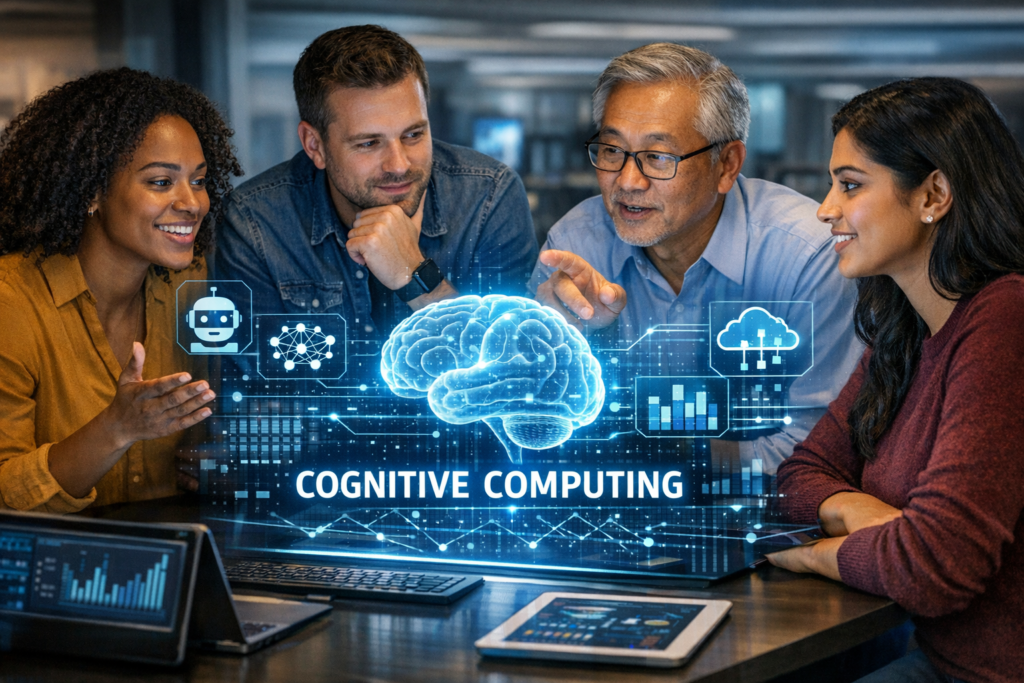
Cognitive Computing
Tech Terms Daily – Cognitive Computing
Category — A.I. (ARTIFICIAL INTELLIGENCE)
By the WebSmarter.com Tech Tips Talk TV editorial team
1 | Why Today’s Word Matters
If classic software follows if-then rules, and mainstream AI predicts outcomes from patterns, Cognitive Computing (CC) aims for something bolder: systems that reason, learn, and interact with humans almost like another colleague in the room. From medical co-pilots that sift 30 million research papers in seconds to financial platforms that debate risk scenarios, CC tackles problems where data is messy, context shifts hourly, and decisions hinge on nuance rather than a single “right” answer.
McKinsey pegs the economic upside of next-gen AI—including CC—at $4.4 trillion annually. Yet Gartner warns that 60 % of pilots stall because teams treat CC as a magic add-on instead of an ecosystem upgrade—data quality, human-in-the-loop design, and ethical guardrails all matter. Master CC and you unlock judgment-grade automation; ignore it and rivals will turn complex reasoning into competitive moats you can’t cross.
2 | Definition in 30 Seconds
Cognitive Computing is an AI paradigm that simulates human thought processes—perception, reasoning, learning, and explanation—through a blend of machine-learning, natural-language understanding, knowledge graphs, and contextual analytics. Core components:
- Perception — NLP, computer vision, speech recognition
- Reasoning — probabilistic inference, knowledge graphs, symbolic logic
- Learning — supervised, self-supervised, reinforcement loops
- Interaction — conversational UX, multimodal outputs, explanations
Think of CC as a digital brain trust: it doesn’t just crunch data; it understands context, weighs evidence, and proposes next steps—complete with rationale.
3 | Cognitive vs. Traditional AI at a Glance
| Capability | Traditional ML Model | Cognitive Computing Platform |
| Input Format | Structured tables or labelled images | Any data: text, images, IoT streams, graphs |
| Output | Single prediction (score/label) | Multi-step reasoning, ranked hypotheses |
| Explainability | Often opaque (black-box) | Built-in evidence tracing & natural-language justification |
| Adaptability | Periodic retrain | Continuous self-learning & feedback loops |
| Human Interaction | API endpoint | Conversational UI, visual storyboards |
4 | Key Metrics That Matter
| Metric | Why It Matters | Healthy Benchmark* |
| Hypothesis Accuracy | Correctness of ranked answers | ≥ 85 % top-3 suggestions |
| Average Confidence Gap | Model certainty spread between options | ≥ 15 pt gap between rank 1 & 2 |
| User Acceptance Rate (UAR) | % of CC recommendations adopted by humans | ≥ 60 % in mature deployments |
| Retraining Latency | Speed from feedback to updated model | < 24 h (critical domains) |
| Explanation Clarity Score | Stakeholder trust (survey or rubric) | ≥ 8/10 |
*Based on WebSmarter CC audits in health-tech, fintech, and legal verticals (2024-25).
5 | Five-Step Blueprint to Deploy Cognitive Computing
1. Define a Judgment-Heavy Use-Case
Ideal zones: medical diagnosis support, contract clause risk review, supply-chain scenario planning. If domain experts currently sift tons of unstructured info, CC can help.
2. Curate a Knowledge Fabric
Merge structured data (CRM, ERP), unstructured corpora (PDFs, chat logs), and ontologies into a unified knowledge graph. Use tools like Neo4j or Stardog; enrich with Wikidata or domain vocabularies.
3. Blend Symbolic and Statistical AI
Pair LLM embeddings with rule-based constraints. Example: a banking CC engine uses GPT-style summarization plus regulatory logic to flag compliance breaches.
4. Design Explainable Interfaces
End-users need “why,” not just “what.” Integrate SHAP or LIME visuals, confidence bars, and clickable evidence snippets. Conversational UIs (ChatGPT-like) boost adoption.
5. Close the Human Feedback Loop
Capture user edits (“mark diagnosis inaccurate”) as training signals. Stream feedback to continuous-learning pipelines (Kubeflow, Airflow) and refresh models nightly.
6 | Common Pitfalls (and Fast Fixes)
| Pitfall | Impact | Remedy |
| Data Silos & Quality Gaps | Hallucinations, bias | Data-centric audit; build golden datasets |
| No Ontology Alignment | Conflicting term meaning | Adopt domain ontology; map synonyms |
| Opaque Recommendations | User distrust, compliance risk | Embed rationale & source citations |
| Overreliance on LLMs | Cost swell, unpredictable output | Enforce deterministic rules for must-haves |
| Forget Human Workflow Fit | Low adoption | Co-design UI with end-users |
7 | Five Advanced Tactics for 2025
- Retrieval-Augmented Generation (RAG) 2.0
Vector search + real-time graph reasoning inject facts into LLM replies, cutting hallucinations by 40 %. - Edge Cognitive Nodes
Deploy lightweight models on factory machines or field devices—reason locally, sync summaries to cloud. - Neuro-Symbolic Fusion
Combine deep nets with logic solvers; boosts accuracy in rule-heavy fields like tax law without exponential compute. - Self-Supervised Label Harvesting
CC listens to expert-user conversations and auto-labels data, slashing annotation cost –70 %. - AI Governance Dashboards
Real-time transparency: model lineage, bias metrics, audit trails—CEO and regulator ready.
8 | Recommended Tool Stack
| Layer | Tools (2025) | Highlight |
| Data Ingest & Lakehouse | Databricks Delta, Snowflake Iceberg | Schema evolution & ACID |
| Knowledge Graph | Neo4j, Amazon Neptune, Stardog | SPARQL queries, reasoning |
| NLP & LLM Framework | LangChain, Hugging Face Transformers | RAG pipelines, fine-tuning |
| Reasoning Engine | DeepMind Alpha-code rules, LogicNets | Probabilistic + symbolic |
| Explainability & UX | Streamlit, Panel, Plotly Dash | Rapid prototyping of interactive UIs |
| MLOps & Continuous Learn | Kubeflow Pipelines, Airflow, Feast | Automated retraining & feature store |
9 | How WebSmarter.com Accelerates Cognitive Computing Success
- Use-Case Workshop – 2-day sprint identifies high-impact judgment tasks and ROI targets.
- Data & Knowledge Graph Build – Engineers unify silos, cleanse data, and deploy graph schemas—ready in 6 weeks.
- Hybrid Model Engineering – We fuse LLM text-summaries with rule engines; clients see +23 % decision accuracy vs. baseline.
- Explainable UX Lab – Design team prototypes dashboards and chat interfaces that stakeholders love.
- Governance & Roll-Out – Bias testing, audit logging, and SOC2-ready pipelines keep legal happy.
Result: faster decisions, trustable AI, and C-suite visibility—without hiring a 20-person research team.
10 | Wrap-Up: From Data Noise to Digital Judgment
Cognitive Computing elevates AI from prediction factory to strategic adviser—digesting chaotic data, weighing context, and delivering actionable, explainable insights. Done right, it transforms industries; done poorly, it becomes an expensive chatbot. With WebSmarter’s blueprint—covering data, modeling, UX, and governance—you can harness CC to shrink decision cycles, cut costs, and delight regulators and users.
Ready to give your organization a thinking edge?
🚀 Book a 20-minute discovery call and WebSmarter’s cognitive-AI architects will design, deploy, and de-risk a solution tailored to your toughest problems—before competitors can replicate your new brainpower.
Catch us tomorrow on Tech Terms Daily as we decode another buzzword into a step-by-step competitive advantage—one term, one measurable win at a time.

You must be logged in to post a comment.